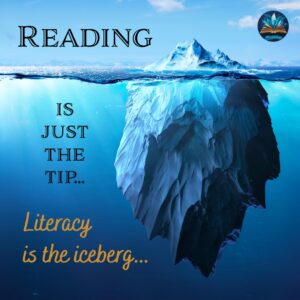
As foundation phase and primary teachers, we spend a massive portion of our day on phonics, sight words, and fluency. It’s easy to feel that if a child can decode a page of text, they are "literate." But as we look closer at the curriculum, we realize that reading is the tool, while literacy is the craft. Understanding this distinction isn't just about semantics—it’s about giving our students the keys to unlock every subject in the classroom.
1. Reading: The Essential Gateway
Reading is the mechanical process of decoding symbols into sounds and sounds into meaning. In the primary years, we focus on what the National Reading Panel calls the "Big Five":
- Phonemic Awareness & Phonics: The "code-breaking" skills.
- Fluency: The bridge between word recognition and comprehension.
- Vocabulary & Comprehension: Understanding the "what" of the text.
While these are the essential building blocks, they are a subset of literacy. A student might be a proficient "reader" of a text about the water cycle but lack the literacy to explain how it affects their own community or to create a diagram representing the process.
2. Literacy: The Holistic "Meaning-Maker"
Literacy is far more encompassing. It is the ability to identify, understand, interpret, and create meaning using various forms of communication. For a primary child, literacy is a multi-sensory experience. It includes:
- Oral Literacy: The ability to listen and speak—often the precursor to reading success.
- Visual Literacy: Interpreting images, charts, and symbols (crucial for Life Skills and Social Sciences).
- Digital Literacy: Navigating technology to find information.
- Critical Literacy: Questioning a story. Why did the character do that? Is this information fair?
3. What the Research Tells Us
Research from UNESCO and the International Literacy Association (ILA) suggests that literacy is a social practice. It doesn't happen in a vacuum.
The Fact: Studies on Content-Area Literacy show that when children engage with literacy skills outside of the dedicated "English Hour" their vocabulary retention and concept mastery increase significantly.
By integrating literacy into "non-literacy" subjects, we provide the intervention many children need without adding more hours to an already cramped school day.
4. Why This is a "Double Win" for Teachers
When we stop seeing literacy as "just another thing to teach" and start seeing it as the way we teach everything, the pressure shifts.
- Win #1: You fulfill curriculum requirements for subjects like Life Skills or Science.
- Win #2: You provide "hidden" literacy intervention, strengthening their reading and writing muscles through diverse contexts.
The Literacy Challenge: One Small Shift for a Big Impact
We know that your timetable is already overflowing, and "adding more" feels impossible. But what if the secret isn't adding more time, but creating more depth? By weaving literacy into your Life Skills or Science lessons through stories, you aren't just teaching a subject—you’re giving a child the tools to decode their world. I challenge you this week to look at one "non-English" lesson and ask: How can I turn this into a literacy moment? You might be surprised at how much more engaged—and empowered—your students become.
Until Next Time...
Thank you for the incredible work you do in the trenches every day. Your dedication to building not just readers, but truly literate thinkers, is what changes the future. I’ll be back next week with more practical tips and stories to help you win in the classroom.
Keep inspiring,
Blueleaf Learning Team