Have you ever watched a child decode every single word on a page perfectly, only to close the book and have no idea what they just read? It’s a common frustration for educators and parents alike.
This 'gap' exists because reading isn't just a single skill—it’s a complex construction project. While phonics provides the bricks, comprehension is the roof that keeps the whole structure standing.
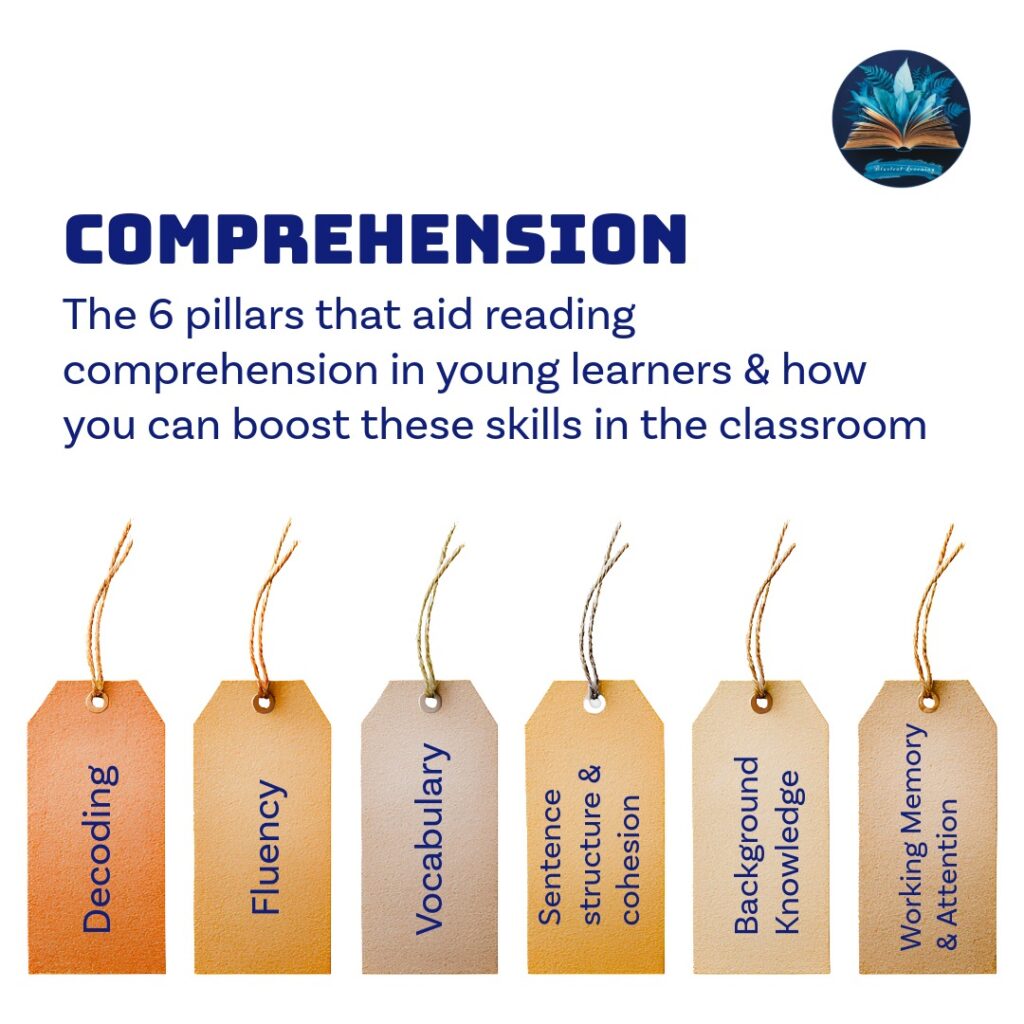
We are here to help close that gap. The solution is not found in more repetitive drills, but rather in developing the 6 pillars of reading comprehension into every lesson!
1. Decoding (Phonemic Awareness & Phonics)
Before a child can understand a story, they have to "crack the code" of the words on the page.
- Phonemic Awareness: The ability to hear and play with individual sounds in spoken words (e.g., knowing that "shark" starts with a /sh/ sound).
- Phonics: Connecting those sounds to written letters.
- The Link: If a child spends all their "brain power" trying to sound out a word, they have no energy left to actually think about what the sentence means.
- How to improve decoding skills: with lots of practicing of key techniques in FUN ways such segmenting words, using multisensory methods like tapping sounds, identifying chunks (digraphs, blends), breaking down long words into syllables, and frequent, repeated reading. There are hundreds of free games available to help support this. Consider adding a basic game to your station rotation.
- Do not assume because a learner has been shown a sound, that they will automatically remember it. It is vital to revise letters, sounds and chunks throughout Foundation Phase!
2. Fluency
Fluency is the bridge between decoding and understanding. It’s the ability to read text accurately, at a good pace, and with proper expression (prosody).
- Why it matters: Fluent readers recognize words automatically. This "automaticity" frees up the brain to focus on the story's plot or the information being shared.
- How do children learn reading fluency? —the ability to read accurately, quickly, and with expression—is learned primarily through repeated, assisted, and independent practice of text at their skill level. Key methods include modeled reading (listening to fluent reading) echo reading, choral reading, and practicing with high-frequency sight words.
3. Vocabulary
A child’s "oral vocabulary" (words they understand when heard) is a massive predictor of their reading comprehension.
- The Gap: A child might decode the word "enormous" perfectly, but if they don’t know it means "very big," the sentence remains a mystery.
- Tip: We encourage all parents & teachers to use "grown-up" words in daily conversation to build this mental library.
4. Sentence Structure & Cohesion
Understanding how sentences are built is vital. This includes knowing how pronouns work and how connecting words like because, but, or finally change the meaning.
- How to improve this skill: Improving sentence construction and cohesion in children involves scaffolding from simple to complex structures, using visual aids, and practicing with sentence-combining games.
5. Background Knowledge
This is one of the most overlooked skills. Reading is a process of connecting new information to what we already know.
- The "Baseball Study" Effect: Research shows that "struggling" readers who know a lot about baseball will actually comprehend a story about baseball better than "advanced" readers who know nothing about the sport.
- Application: This is why Blueleaf Learning’s themed stories about academic topics are so effective—they build the knowledge base children need to understand future texts.
6. Working Memory & Attention
Reading is a multi-step mental juggle.
- Working Memory: Allows a child to hold the beginning of a sentence in their head while they reach the end.
- Attention: Helps them stay focused on the "clues" in the text rather than getting distracted by a picture or a stray thought.
- How to help with improving working memory and attention: Improving working memory and attention in children involves breaking tasks into small, manageable steps, using visual aids, and employing multisensory techniques. Key strategies include creating consistent routines, limiting distractions, encouraging active, hands-on play, using memory games, and ensuring adequate sleep.
7. How One Story Can Build the Six Pillars of Reading
At Blueleaf Learning, we believe that the six pillars of reading comprehension do not need to be taught in isolation; instead, they can all be powerfully addressed through the heart of a good educational story. By weaving these essential skills into a narrative, we move from abstract drills to "living literacy," where children see exactly how sounds, words, and knowledge snap together to create meaning.
Here is how a single story can act as a vehicle for all six pillars:
- Decoding: A story serves as a "sound laboratory" where teachers can pause to model segmenting and blending (e.g., /sh/-/ar/-/k/) or hunt for specific letter patterns (digraphs) within the sentences.
- Fluency: Re-reading a favourite tale or performing a "Reader’s Theatre" allows children to practise reading with expression and pace, turning "choppy" word-calling into smooth, melodic speech.
- Vocabulary: Stories introduce "tier-two" words—like enormous or cautious—within a meaningful context, making it much easier for a child to bank these new terms than through a list of definitions.
- It also promotes academic vocabulary- themed vocabulary taught at school.
- Sentence Structure: By seeing how a story is built by a model text, children can learn how pronouns work and how connecting words like because or after change the timing and logic of a sentence.
- Background Knowledge: A story about a themed concept at school builds a child’s "mental library" of facts, providing the essential context they need to understand more complex texts in the future.
- Working Memory & Attention: Following a plot from beginning to end trains the brain to hold onto information, link clues together, and stay focused on the "big picture" until the final page.
In closing
Research indicates that comprehension is improved by up to 70% when a child is read a story on a topic, in comparison to receiving a worksheet/verbally taught in class!
By using a narrative as your 'blueprint,' you aren't just teaching a child to bark at print; you are giving them the foundation, the walls, and the roof they need to dwell safely in the world of words.
Let’s stop treating reading skills like isolated drills and start seeing every storybook as an opportunity to strengthen all six pillars at once.
Happy reading!